 Born Leconfield, Beverley, 04/11/1893. Eldest child of John Robert Dickins (1865-1943) and Annie Maria Brusby (1875–1927), of 27, Leconfield, East Yorkshire (War Pension address). His father was born in Shipton, Yorkshire. His mother was born in Leconfield.
Son of a shepherd. George had three brothers, Charles Richard, James Wilfred and Harold Edwin Dickins. He also had two sisters, Rhoda Ann and Alice Rita Dickins. All his siblings were unmarried and lived at home, with their parents.
George was also a single man, who moved to T Roberts, Moorhead, Sheffield, to work as a Draper’s Assistant.
His army medical records describe him, as 5 foot, 10.5 inches tall, 36.5 -38.5 inch chest, 147 lbs weight, “fair” physical development, and Church of England religion.
He enlisted at Sheffield, on 09/12/1915. Called up, on 01/02/1916. He served with the 9th Battalion York & Lancaster Regiment. The battalion was raised in Pontefract in September 1914, and undertook training at Frensham, Aldershot, Hythe and Bordon before proceeding to France in 1915. George trained as a Trench Bomber and left Folkestone for Boulogne on 02/02/1916. He was promoted in the field, to Lance Corporal, on 18/05/1916.
On the 1st July 1916, eight battalions of the York and Lancashire Regiment went over the top. The 9th Battalion took part in the attack on the village of Ovillers at 8.40am following the attack by the 8th K.O.Y.L.I. and the 8th York and Lancaster. Their area of attack was to the north of the village. The leading waves cleared the German 1st Line and entered the second line – but here they were forced to withdraw due to the heavy machine gun fire coming from surrounding high ground (Thiepval Spur). They suffered a great number of casualties, losing half their number crossing No Man’s Land. (Out of 25 officers and 736 ‘other ranks’ only 180 returned). George was wounded and died of wounds, the next day, on 02/07/1916, aged 22.
He had served in the army for 209 days and was awarded the British War Medal and Victory Medal. He is buried at Ribemont Communal Cemetery Extension, Somme, France.
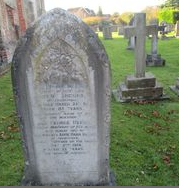
His army effects and war pension went to his father, John Robert Dickins. George is remembered on the family grave at St Catherine’s Churchyard, Leconfield, East Yorkshire.
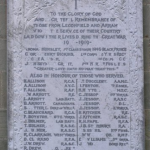
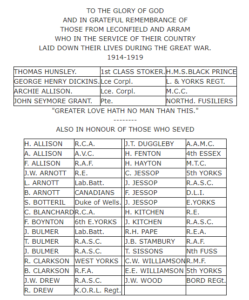
His name is also listed on the Arram & Leconfield WW1 Memorial (35 served, 4 died).
Notes: On the far left flank of their sector, the 14th Sherwood Foresters and the 9th York and Lancaster’s were ordered to attack up hill eastward from the eastern edge of Authuille Wood, along a line just to the south of The Nab crossroads. The German front line was well entrenched and, a short distance to the north of the Battalion’s line of advance, the German line turned westwards to form the Leipzig Salient, known to the British as the Thiepval Spur. Consequently, the battalion was exposed to devastating fire from high ground ahead of them and on their left.
Lieut G.H. Williams, Transport Officer, 9th York & Lancaster Regt on July 1st, wrote to his wife:
After days of wind & rain the day has dawned clear & fine. The fates are kind so far – and today is “Der Tag. It is now nearly half past eight and I am down in my transport lines standing by to move forwards at 15 minutes notice. For a week now our guns have pounded away at the Bosche. Every night the sky has been lit by the flashes of our guns like summer lightening. Last evening one battalion moved up into the trenches and all night the bombardment has increased in intensity, until here where I am the ground shakes under the roar of our guns.
An hour ago we went over the parapet – so far as I have heard no news.
Later since I wrote the above secondhand news had been trickling in to us. I have seen several slightly wounded men, but their stories are so at variance that it is impossible to know exactly what has happened. It has been no walk-over; that we do know, and the tide of battle had swayed back & forth. I have heard that Thomas has fallen, and that – (here he mentions several officers) are wounded. I heard that early on in the day so the Gods alone know who is left now.
The stream of wounded men increases, but there is also a stream of Hun prisoners.
If we only knew what was happening it would not be so bad.
The guns never cease, in front of us the shrapnel bursts – and over all – a summer sun in a cloudless sky. As I write this I can hear a lark just over head singing away as joyfully as though . . . . . . . . . . . .
July 2 Since I wrote the last lines years seem to have passed, and yet it is only twenty four hours later and I am back sitting in my dug out.
We went forward yesterday against a storm of death against which no man born of woman could stand. One day the history of what our Brigade did will be written; at present I know little. I know that we charged again & again.
Last night another lot came up and took over the trenches from us and from midnight until four this morning Paspe [?] and I were up at the mount [?] of the trenches collecting the men of the Brigade as they came out. We had taken up every wagon of the transport, and as the men stumbled out we shoved them into the wagons & they were driven off here. I never want to see it again beloved – these weary shattered men stumbling out.
Captain Price came out unwounded and two other young officers only recently joined – that is all.
[A copy of this letter was kept by Harry Thomas, father of 2/Lt Wilfrid Pattrick Otto Thomas, who was killed that morning.]
Many of the 9th York & Lancasters were buried in Blighty Valley Cemetery, Authuille Wood, in Normandy, about three miles north of Albert, mid-way between the villages of Avuly and Authuille, 4 km north-east of the town of Albert. The cemetery is situated in a valley half way between these two villages on the D151. (Cemetery is signposted on exit of Aveluy direction Authuile. The Cemetery is on the eastern side of the road D151 and access is 500 metres by grass pathway, unfit for cars. Just over 1,000 1914-18 war casualties are commemorated on this site, over half unidentified. Blighty valley was the name given by the Army to the lower part of the deep valley between Authuile and Aveluy. The upper part of the valley was called Nab Valley.