Hull City Police Force WW1 Memorial Plaque
| Name | Rank | Regiment | Died | Age | Buried | No: | Address |
| Mitchell, Ernest Frederick | Pte | Coldstream Guards, 3rd | 15/09/1916 | 24 | Thiepval, Somme, France | 3 | Wyndham Street, Hull |
| Edlington, MM, John Holmes | Pte | Coldstream Guards, 1st | 27/08/1918 | 24 | Croisilles British Cemetery, Pas de Calais, France | 7 | Park Terrace, Seaton Street, Hull |
| Bird, William | Pte | Coldstream Guards 2nd | 26/10/1914 | 30 | Perth Cemetery, China Wall, Ypres, Belgium | 22 | Glasgow Street, Hull |
| Markham, Percival Charles | Pte | Lincolnshire Regiment, 1st | 14/09/1914 | 28 | Marne, France | 3 | Kimberley Avenue, Seymour Street, Hull |
| Weston, Harry | Pte | 12th East Yorkshire Regiment (Hull Sportsmen) | 13/11/1916 | 32 | Thiepval, Somme, France | 4 | Worsley Street, Beverley Road, Hull |
| Filby, Ernest | Gnr | Royal Field Artillery 161st Brigade A Battery | 13/07/1917 | 27 | Adinkerke Military Cemetery, Belgium | 7 | Estcourt Street, Hull |
| Robson, Arthur | Pte | Northumberland Fusiliers, 2nd | 05/06/1917 | 26 | Arras memorial, France | 113 | Finkle Street, Cottingham |
| Thompson, Arthur | 2/Lieut | Northumberland Fusiliers 24th Battalion (1st Tyneside Irish) | 23/10/1917 | 26 | Tyne Cot Memorial, Belgium | Norfolk Street, Hull | |
| Gray, William | Gnr | Royal Garrison Artillery 81st Siege Battery | 25/08/1918 | 25 | Bailleul Communal Cemetery Extension, Nord, France | 3 | Mona Avenue, Cave Street, Hull |
| Stainton, George Alfred | Cpl | Royal Field Artillery, 81st Siege Battery | 17/10/1918 | 27 | Gainsborough Cemetery, Lincolnshire | 46 | Hutt Street, Spring Bank, Hull |
| Sowersby, Stanley Robert | Gnr | Royal Field Artillery 32nd Brigade, Hull Divisional Ammunition Column | 23/10/1918 | 29 | Vadencourt British Cemetery, Aisne, France | 2 | Etty Grove, Wyndham Street, Hull |
| Porter, John Ernest | Cpl | 1/4th East Yorkshire Regiment (Territorials) | 27/05/1918 | 25 | Soissons Memorial, Aisne, France | 5 | Clifton Gardens, St George Road, Hull |
| Shipley, Sidney | Pte | Durham Light Infantry, 29th | 14/10/1918 | 28 | Hazebrouck Communal Cemetery, Nord, France | 7 | Calthorpe Gardens, Newington Street, Hull |
| Stow, Alfred | Sgt | West Yorkshire Regiment, 1st | 09/10/1919 | 32 | Hull Northern Cemetery | 56 | Goddard Avenue, Hull |
| Cooke, DSM, Harold | Chief Engineer | Royal Naval Reserve, Minesweeper | 21/10/1918 | 28 | Hull Western Cemetery | 7 | Ferens Villas, Rosmead Street, Hull |
| Mitton, George William | L/Cpl | Military Police | 10/08/1920 | 53 | Hull Western Cemetery | 9 | Catherine Square, Mason Street, Hull |
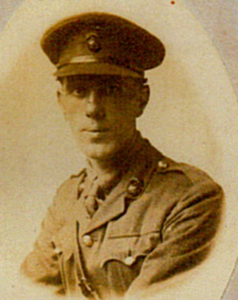
Up to 144 Hull policemen served during World War One and many more would have joined the Army if they could have been spared.
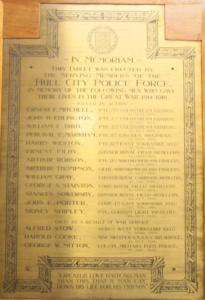
The Police Memorial Plaque to the 16 Hull policemen killed in World War 1, was unveiled by Canon George Buchanan on 22nd January 1923.
Most of the sixteen men on the memorial, were young, married men who left widows, children and siblings. Only Ernest Filby was a single man.
Ernest Mitchell and William Bird also lost two other brothers in the war. John Edlington; Arthur Thompson, Alfred Stow and John Porter also had a brother killed to compound their family’s loss.
Most men were born in Hull and the East Riding and had worked in the fields and factories before joining the police. The first to enlist was George Alfred Stainton, who was wounded twice and gassed once.
Two men were decorated for bravery (not shown on the plaque). Private, John Holmes Edlington was awarded the Military Medal (MM) in France. Chief Engineer, Harold Cooke, was awarded the Distinguished Service Medal (DSM) for his mine sweeping activities at sea.
Most men were served in the ranks. Second Lieutenant, Arthur Thompson was the only army officer on the memorial and died with 1st Tyneside Irish.
Three of the sixteen men died of wounds after the war. Harold Cooke died of pneumonia. George William Mitton, discharged from the Military Police, on 1st November 1917, died on 10th August 1920, aged 53. (His two sons served and survived the war). Alfred Stow was a repatriated prisoner of war who died of wounds in 1919.
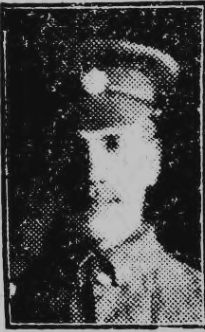
There are a number of errors on the plaque. For example, Ernest Mitchell died in 1916, not 1914. Edlington served in the 2nd Coldstream Guards, not the 1st battalion and died on 27/08/1918, not 1914. Similarly, Sidney Shipley died on 14/10/1918, not 10/10/1916. Such errors are common on many memorials and should not detract from the sentiment of the plaque. The list of names above represents the correct details that correspond with official Commonwealth War Grave records. Ages and home address are also included for interest. A number of photographs of the fallen policemen were published in local newspapers and are are included below.
The Police memorial is a rectangular brass plaque, with stepped top and an incised border of laurel leaves. The Kingston upon Hull City Police crest is etched at top-centre, enclosed within a laurel wreath. Beneath, the incised inscription is in black lettering. [The plaque was originally fixed to a wooden backboard, as was the Force’s WW2 plaque when that was erected in 1951. At some point since, both plaques have been removed from their backboards, and set into a shared frame. The inscription reads, IN MEMORIAM/ THIS TABLET WAS ERECTED BY/ THE SERVING MEMBERS OF THE/ HULL CITY POLICE FORCE,/ IN MEMORY OF THE FOLLOWING MEN WHO GAVE/ THEIR LIVES IN THE GREAT WAR 1914-1918/ KILLED IN ACTION/ (13 names)/ DIED AS A RESULT OF WAR SERVICE/ (3 names)/ “GREATER LOVE HATH NO MAN/ THAN THIS, THAT A MAN LAY/ DOWN HIS LIFE FOR HIS FRIENDS”
The Hull Daily Mail 22/1/1923, page 6, printed a lengthy report of the unveiling, the salient sections of which read: “LEST WE FORGET! GENERAL MAXSE UNVEILS HULL POLICE MEMORIAL. LESSONS, OF THE WAR”. A notable event in the history of the Hull City Police Force was the visit on Sunday to the Central Police Station, of General Sir Ivor Maxse, G.O.C. Northern Command, at York for the purpose of unveiling a tablet as a memorial to 16 members of the police force who were either killed in action, died of wounds, or died as the result of war service. The presence of a number of members of the force lined up as a guard of honour inside the police station, near the wall on which the handsome tablet has been fixed, wearing various decorations, showed that they had themselves a war record. One of the police constables wore on his breast six different medals, and there were two or three other old police soldiers wearing three or four medals.
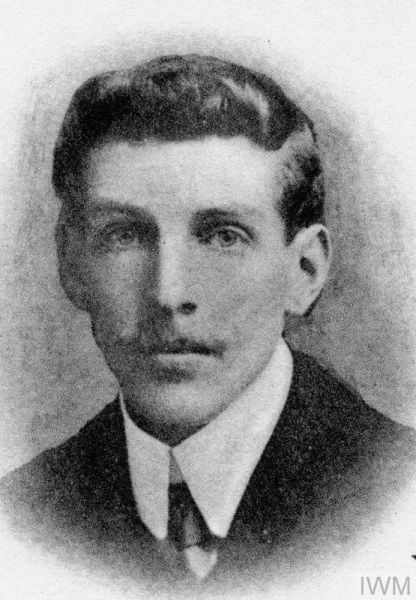
The tablet—a large and artistic piece of work in brass—stated the Chief Constable, had been erected by serving members of the police force in memory of 16 fallen comrades, as follow:— KILLED IN ACTION. Pte. Ernest F. Mitchell, 3rd Coldstream Guards. Pte. John H. Edlington, 1st Coldstream Guards. Pre. William E. Bird, 2nd Coldstream Guards Pte. Percival E. Markham, 1st Lincoln Regiment. Pte. Harry Weston, 12th East Yorkshire Regiment. Gnr. Ernest Filby, R.F.A. Pte. Arthur Robson, 21st Northumberland Fusiliers. Lieut. Arthur Thompson, Northumberland Fusiliers. Gnr. William Gray, R.G.A. Corporal George A. Stainton, R.F.A. Gnr. Stanley Sowersby, R.F.A. Corporal John E. Porter, 4th East Yorkshire Regiment. Pte. Sidney Shipley, Durham Light Infantry, DIED AS A RESULT OF WAR SERVICE Sergt. Alfred Stow, West Yorkshire Regt. Minesweeper Harold Cooke, H.M. Navy (Aux. Service). Lance-Corporal George W. Mitton. Military Foot Police. A large number of members of the local Watch Committee, and representative citizens were present, including the Lord Mayor and Mrs C. Raine, the Sheriff (Mr Dean), Mrs Dean, Ald. Crook, J.P. (Chairman of the Watch Committee), Canon George Buchanan (in place of the Bishop of Hull), Councillor and Mrs Wokes, Mr Hubert Johnson, J.P., Major A. J. Atkinson, J.P.. Col. James Walker, D.S.O., J.P.. Mr G. Morley (former Chief Constable of Hull), Capt. Woods (the present Chief Constable), and Mrs Woods, Commander and Mrs Walton, R.N., Mr James Downs, J.P., and Mrs Downs, Councillor J. W. Locking, Ald. and Mrs T. S. Taylor, Ald. F. Askew, Councillor and Mrs W. M. Mackenzie, the Rev Dr E. Dalton, Rev T. Macrae Todd, Dr J. Wright Mason, Col. Grant, Major Dunlop (Chief Constable of the East Riding), Mr Carpenter (Chief Constable at Beverley) and Mrs Carpenter, Supt. Huddlestone (East Riding Police), Capt. J. E. Johnson, Councillor Toogood, D.C.C. Kilvington, Mr Stirling (Chief Constable of Grimsby), and many others.
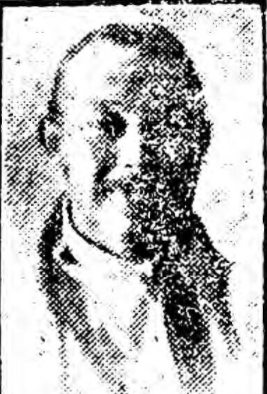
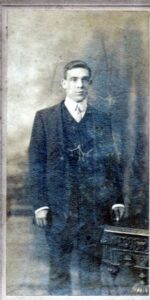
The ceremony was quietly impressive. The Police Band played selections, and accompanied the hymn “O God, our help in ages past.’ The Last Post was sounded by four boy buglers, and the Band sounded the Reveille”. The Chief Constable (Capt. Woods) was quoted as having remarked that “they were proud of the war record of the Hull City Police Force. Upwards of 144 members of the force served in the war, and that did not represent the full number who would have joined the Army if they could have been spared”. Before unveiling the tablet, General Maxse commented that they had “assembled chiefly to mourn for 16 members of the Police Force who gave their lives, but they had also, he thought, at the back of their mind, a feeling of thankfulness that they won the war”. (His full speech was printed in the report). The report of the unveiling ceremony closed with the remark that “The memorial was designed and carried out by Messrs R. Johnson and Sons, Lowgate, Hull”.
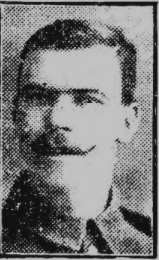
The Hull City Police Force was established on 2nd May 1836. It originally comprised of four inspectors, three acting inspectors. nine sergeants and seventy seven constables. The rise in strength and status of the police force ran almost parallel with the rise of Hull itself, with the town gaining city status in 1897. Over the years the Hull Force had many Headquarters and saw many changes and reorganisations, before amalgamated into Humberside Police in 1974. See – https://british-police-history.uk/f/hull-city
