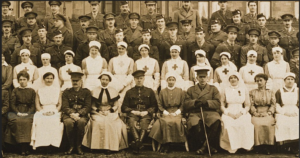
The conditions experienced by soldiers in the trenches of the Western front were unique. The use of mechanical warfare with high explosive and rapidly firing heavy artillery aimed at men restricted in trenches with no route of escape, meant that conditions were more destructive and oppressive than had ever been previously experienced. High explosives, gas, flame throwers, tanks, aircraft, were all used for the first time and the effect of sustained gassing, shelling, and bombing led to a dreadful injury and mutilation. Out of the brutality of this modern warfare, emerged the condition known as “Shell shock”, probably the most tragic illness in World War 1. It was the condition that left troops in WW1, blind, deaf, mute and paralysed after the trauma of the trenches. “Shell Shock” affected both the soldier’s mind and performance. Survivors could sometimes not recognize their families or communicate with them properly. Typified by fatigue, bodily pains, tremor, headaches, poor memory and concentration, together with weakness and difficulty undertaking tasks, their symptoms aligned with no recognised form of illness. With no known cure, victims were often committed to asylums for the insane.
At the time, shell shock was believed to result from a physical injury to the nervous system during a heavy bombardment or shell attack, later it became evident that men who had not been exposed directly to such fire were just as traumatised. By December 1914, as many as 10% of British officers and 4% of enlisted men were experiencing “nervous and mental shock”. There are accounts and photographs of silent, shuffling men tormented by nightmares and hallucinations, often paralysed, amnestic, or mute. 80% of shell shock victims were unable to return to military duties. About 25% of those discharged from active service during the war were ‘psychiatric casualties’. With 1.7 million servicemen wounded during the entire war, a rate of 20% suggests that around around 250,000 men were affected by shell shock in some form. Approximately 110,000 men applied for pensions for shell shock-related disorders in the decade following 1919 costing the government more than GBP £10 million per year.
“Shell Shock” was a new illness that had never been seen before on this scale. The condition was poorly understood medically and psychologically. Today, the condition is known as post-traumatic stress disorder and the treatment and attitude to it are very different. Shell-shock, was initially viewed by the public as a sign of emotional weakness or cowardice. Many shell shock victims felt shame on their return home and some were treated as deserters. Senior Generals were equally unsympathetic. Unpersuaded by the medical evidence, the military framed shell shock as an issue of wasted manpower, rather than illness. They believed psychological casualties could be prevented by careful recruitment, good training and strong leadership. Soldiers were more likely to have been punished for the effects of mental breakdown during the early and middle years of the war than in 1918. The number of executions, for example, fell from 88 in 1916, 88 in 1917 to 35 in 1918. The reduction may have reflected a growing appreciation and public awareness of psychological trauma and its impact. Other punishments, included, solitary confinement, emotional deprivation, electric shock treatment, shaming and physical re-education.
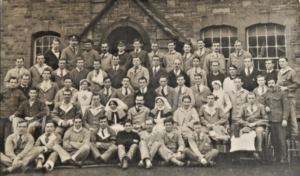
By Spring 1915, the numbers of shell shocked wounded had increased and showed no signs of diminishing. Between July 1916 and November 1916, 419,600 British soldiers were killed or wounded. The exact figure is not known, but based on rates experienced in other battles and by the other countries like France and Germany, where casualty statistics are available, it is likely that at least 65,000 British soldiers would have been admitted to medical units suffering from shell shock. The military wish to maintain that shell shock was cowardice or lunacy was no longer tenable. Shell shock was a great leveller. All ranks were exposed to the extreme conditions that brought it on and both officers and men capitulated under the strain with large numbers of soldiers being admitted to Base Camp Hospital with severe and profound functional symptoms such as paralysis or loss of speech. It became increasingly clear that soldiers accused of cowardice and desertion and “shot at dawn” were often suffering from shell shock, depression, or mania.
The term “shell shock” was eventually coined in Spring 1915 by medical officer Charles Myers. It was also called “war neurosis” and “combat stress” and later post-traumatic stress disorder (PTSD). By early 1915, there was an acute shortage of hospital beds leading to the requisition of many country “lunatic asylums,” private medical institutions, spas and hotels for the treatment of war neurosis. The number of soldiers became a flood and the War office and military establishment became desperate to treat the soldiers and return them to the front as quickly as possible.
An extrapolation from the official medical history of the Great War suggests that 325,300 servicemen were treated for neuropsychiatric illnesses during the conflict. The scale of the problem led to the creation of specialist treatment units both in France and the UK. By 1918, there were 20 Hospitals for shell shocked soldiers in Britain. They included (for officers) Craiglockhart War Hospital in Edinburgh and patients diagnosed to have more serious psychiatric conditions were transferred to the Royal Edinburgh Asylum. In May 1918, Asylums, such as Beaufort in Bristol, were converted into war hospitals for psychiatric patients. East Leeds War Hospital also treated shell shock patients. A growing number of centres, such as the Royal Victoria Hospital in Southampton and Seale-Hayne, in Newton Abbot, under the pioneering guidance of Dr Arthur Hirst, specialised in treating neurological cases with humanity and dignity. A new war hospital was built in Cardiff and Dr Edwin Goodall was famed for his therapeutic techniques, as the medical superintendent of the Welsh Metropolitan War Hospital during the war. 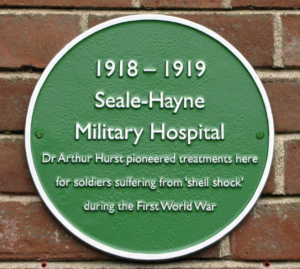
The recognition and clinical experience gained in treating shell shock during WW1 established the sub speciality of military psychiatry. Although the Ministry of Pensions granted 84,680 war pensions for neuropsychiatric disorders (6.3% of the total) and for a brief period financed out-patients clinics for the treatment of shell shock, many veterans traumatised by war received little therapeutic care during the 1920’s and 1930’s. The Ministry had hoped to successfully treat shell shock patients, but its therapeutic targets were not met and in 1926 it concluded that ex servicemen with psychological disorders were unlikely to be cured. Indeed out of the 65,000 war pensions for shell shock in 1921, 30,220 remained in payment in 1936, suggesting no appreciable change in the veterans’ symptoms and function.
In Britain during the late 1930’s, 639,000 former soldiers and Officers were still drawing WW1 disability pensions. This figure included 65,000 men whose disabilities were not physical, but mental. Some servicemen were so traumatised by the experiences in the First world war, that they spent the rest of their lives in hospital.
Post War Shell Shock
The war had put a terrible strain on people, particularly on those who were suffering from combat stress. There was a moral panic immediately after ww1 that returning veterans brutalised by war would fuel violent crime in Britain. In 1919, The Times reported 110 cases of murder, attempted murder and threats to murder. The News of the World reported the same stories with another 17 cases. Soldiers and demobbed soldiers were identified suspects in 42 of the 127 cases (one third).
The Commissioners of Prisons in July 1920 reported that out of a total prison population of under 40,000, 6,461 were men who served in the armed forces, of which 3,411 were first time offenders and 1,398 ‘habitual criminals’, the remainder being prisoners transferred from military prisons in France. The report highlighted that “A large proportion of these ex-soldiers were young men, some earning good wages at the time of their committal and that they were not prompted to commit crime because of want, but through sheer lawlessness – which may not have been due to criminal instincts, but generated by the conditions of active service in different parts of the world, where the normal restraints of conduct had been banished by the stress of war.’
Between January 1919 and December 1920, 70 men who had served in the armed forces during the war were convicted of homicide in England, Scotland and Wales, with 51 being found guilty of wilful murder and sentenced to death. Of these, 24 were hanged, 16 judged to be guilty, but insane and committed to asylums, and 11 had their death sentences commuted.
The press no longer restrained by Government censorship highlighted many murders where insanity due to “Shell Shock” was used as the primary defence in the murder. In 1919, there were six murders cases involving ex-servicemen where three men were found guilty, but insane and committed to asylums.
Sidney Hume, a Royal Flying Corps pilot was shot down in France in May 1917 and captured by the Germans. Following his repatriation in August 1918, he was diagnosed with delusional insanity and admitted to Latchmere House Military Hospital for shell shocked officers. On 30 November 1918, Hume shot dead one of the male orderlies, telling police “I am not mad… it was for the benefit of England”, He later claimed that he had been hypnotised and experimented on by German doctors and thought the same treatment was being carried on at Latchmere Hoses.
Harry Bohle, a private with the 2nd Battalion, South Staffordshire Regiment, was wounded several times and ‘blown up by shells three times in one day’. Doctors who examined him admitted that he had a ‘mental instability’ caused by the ‘hardships and strains’ of war, although ‘divergent views were given as to the effects of shell shock. Bohle was found guilty of cutting his girlfriend’s throat, but in his summing up the judge stated that “it is quite obvious the prisoner was not normal in his physical and mental system.”
Arthur Hopwood, returned home after three years’ service as a private with the Lancashire Fusiliers ‘dazed and emotional’, unable to recognize everyday objects and plagued by voices urging him to commit acts of violence. When asked about the war. He thought that Britain had been fighting France and could not recall on whose side the Germans had fought. Hopwood also suffered from the loss of sensation in the arms, legs and face, and hyperreflexia (an overactive muscular reflex response). His condition was so bad a Jury found him insane and unfit to plead to the charge of murdering 45 year old Edith Manning. Two other men had their death sentences commuted;
Roy Joseph Hutty, was an American citizen, who served with the Canadian Expeditionary Force. On 24 July 1919, while a shell shock patient at David Lewis Hospital in Liverpool, he shot dead one of the nurses who refused to marry him. Hutty was reprieved, but hanged himself in his cell at Maidstone Prison three years later.
George Rowland, had enlisted in the army in April 1915 and was gassed and wounded in action three times. He left the army in February 1919 with a good record, but after his demobilisation he began acting ‘peculiarly’ on one occasion threatening his sister with a razor and shouting “Jerry is coming over the top”. On 31 May 1919, Rowland cut the throat of his 18 year old girlfriend and was sentenced to death, but following a strong recommendation for mercy by the jury this was commuted to penal servitude for life.
Henry Perry, however was granted no such clemency. By the time that he enlisted in the Suffolk Regiment in 1916, he was already a hardened criminal with a string of convictions for violent crimes and robberies. While serving in Palestine in 1917, he was captured by Turkish forces and spent the rest of the war as a Prisoner of war, later claiming to have been repeated beaten and tortured. On 28 April 1919, Perry brutally murdered his step aunt, Alice Cornish, her husband Walter and their two young daughters at their home in Forest Gate. At the trial, three eminent experts in mental illness concluded that his ill-treatment at the hand of the Turks, combined with epileptic seizures allegedly caused by a piece of shrapnel embedded in his brain, had rendered him of unstable mind and not responsible for his actions. The prosecutor, Sir Percival Clarke took a different view, stating that “the brutalities of war may have made more vicious a person who was vicious before”. The Jury agreed and took barely ten minutes to find Perry guilty of murder with no recommendation for mercy. At his appeal hearing, Perry was described as being ‘quite wrong in the head.. as a result of treatment he received as a Prisoner of War’. It was also argued that his epilepsy meant he was incapable of distinguishing right from wrong and unable to remember what he had done. The Home Secretary dismissed his appeal and Perry was hanged at Pentonville on 10 July 1919.
Five further shell shock cases came to trial in 1920.
Charles Henry Smith, a private with the 2nd battalion, Worcestershire Regiment, sustained a serious gunshot wound to his left hand at Mons in August 1914 and was later discharged with shell shock and delusional insanity. A police Inspector, who had known Smith for 20 years, described him as “a steady, hardworking man”, but following his discharge from the army in March 1915, “he had been strange in his manner”. Smith’s mother also expressed concern about his increasingly depressed state and odd behaviour. On the evening of 28 March 1920, Smith cut the throat of his five year old son with his army jack knife then attempted to cut his own jugular vein. Just before the attack, he was heard to say “My son is a cripple, and we will both die together”, but after his arrest he claimed to have no recollection of what he had done, Smith was said to have been ‘very fond’ of his son, but he ‘remained unmoved’ at his Birmingham Trial in April 1920. The jury found him guilty, but insane and he was ordered to be ‘detained during the King’s pleasure’.
An even more disturbing case of filicide was that of William John Howes, who on 28 May 1920 raped and murdered his 13 year old daughter. Howes, a former private with the 1st Battalion, Suffolk Regiment, fought at Loos in February 1915 and was later blown up by a high explosive shell near Ypres. While serving in Salonika he contracted malaria, dysentery and syphilis and also developed symptoms of shell shock. On his discharge from the army in August 1918, an Army Medical Board found him to be ‘tremulous in every limb, to have hesitancy in his speech, to complain of weakness, insomnia, and general pains and to be unfit for any form of military duty’. A police report concluded that Howes was insane and not responsible for his actions, a view endorsed by the prison medical officer and several doctors. It was also noted that Howes was delusional, believing his wife ‘had beetles in her throat’ and that she had poisoned his food and infected him with syphilis. The jury fund Howes guilty of murder, but recommended mercy and in November 1920 he was reprieved and sent to Broadmoor.
Samuel Westwood, a private in the 2/6th Battalion, South Staffordshire regiment, was blown up by a shell on 21 March 1918 which rendered him unconscious for 24 hours. He was then taken prisoner by the Germans and remained in captivity until his repatriation in December 1918, later claiming that he was ‘underfed and overworked’ in a coal mine. On 11 September 1920, Westwood stabbed to death his teenage wife of barely two months after a domestic argument and swallowed what he thought was poison in an attempt to kill himself. At his trial a doctor called by the defence stated that the effects of being ‘knocked down by the shell explosion and experiences as a prisoner of war might have affected Westwood ‘such that he reacted somewhat violently to emotional stimuli’. The Jury was not sympathetic and found Westwood guilty of murder and he was hanged at Winston Green Prison in Birmingham on 30 December 1920.
The final two cases both involved junior officers and aroused considerable press and public interest.
Frederick Rothwell Holt (always known as Eric Holt) shot to death Kathleen Elsie Breaks, at the Sandhills of St Annes on Sea, Lancashire, on 23 December 1919. The couple had been involved in a tempestuous, 18 month affair and it initially appeared to be a crime of passion. However, it later emerged that Holt had insured Mrs Breaks’ life for £5,000 which she left to him in her will. At his trial in Manchester in February 1920, Holt was represented by the leading defence lawyer of his day, the charismatic Sir Edward Marshall Hall. He made much of Holt’s previous service in France with the 1/4th Battalion Loyal North Lancashire regiment, where in 1915, he had endured ‘the nerve-wracking, nerve killing experience of the Festubert bombardment.. listening to the pounding of those shells above, with the ghastly noise that drove men mad’, Army Medical Board reports, made after Holt returned to England in June 1915, described him as ‘thin and nervy’ with distinct signs of ‘neurasthenia’ (a common euphemism for shell shock) resulting in ‘loss of confidence, impaired memory, poor concentration, headaches and considerable mental depression’. Evidence was also given by three doctors who specialised in mental illness and Holt was suffering with delusional insanity and was not responsible for his actions. Even ‘the very definite inheritance of mental disorder’ on the maternal side of Holt’s family was insufficient to persuade the jury that Holt was insane at the time that he killed Mrs Breaks. He was found guilty with no recommendation for mercy and sentenced to death. An appeal hearing followed at which Sir Edward Marshall Hall attempted to have the verdict changed to ‘guilty but insane, arguing that Holt acted on an ‘irresistible impulse’. It was also revealed that in 1917 Holt was diagnosed with secondary syphilis and the doctor who treated him stated that for a man suffering with shell shock this might affected his nervous system and undermined his willpower. Marshall Hall never doubted that Holt shot and killed Mrs Breaks, but he was equally sure that ‘the deed was done under the influence of some sudden uncontrollable passion acting on a mind affected by shell shock and disease’. He felt so strongly that Holt was now mad and that he couldn’t contemplate with honour the idea of executing a madman, saying, “It is not a case for the lawyer, but for the mental specialist”. Several newspapers expressed similar concerns about the case which the press had dubbed ‘The Sandhills Murder’. The Daily Dispatch’ posed the provocative question ‘Shall we Hang the Insane?”. The Yorkshire Post argued that Holt had suffered from the mental strain of war service. The Sheffield Daily Telegraph considered it “painful to think a man who had borne His Majesty’s Commission and had fought and bled for his country, could be capable of such infamy as this’. But ‘did the suffering caused by war, influencing a temperament naturally moody and unstable, bring about this horrible perversion? Here is a deep and anxious psychological problem, but the law cannot take it into account’.
There was also criticism of the legal process by which the verdict had been reached. The Daily Dispatch doubted whether a jury was ‘a fit body to decide when the experts disagree’. One of Marshall Hall’s correspondents agreed – “How can the men who have remained at home, in quiet and safety, be competent to judge the brain waves of a man who has seen so much death that it is almost of no importance?…. Why is the jury for such cases not composed of men who have been in the trenches and in Mesopotamia, and know all the horrors and how these can affect some men?” However, the Home secretary turned down all Eric Holt’s appeals for clemency and he was hanged at 8am, on the 13 April 1920 at Strangeways Prison in Manchester.
Albert Edward Redfern, was 24 years old and a former Lieutenant, in the 1/5th Devonshire Regiment. While serving in Palestine in April 1918, he had suffered severe shrapnel wounds, one piece remaining in his spine and causing partial paralysis. He underwent many months of treatment and several painful operations. In 1919, he then began to experience periods of memory loss and increasingly frequent fits during which he was ‘in a state of absolute irresponsibility yet afterwards he seemed to be quite unaware of where he had been or what he had done’. On the afternoon of 11 December 1919, Redfern carried out an armed robbery at the Leeds Penny Bank, during which he shot dead the bank manager and escaped with over £400. During his trial at Leeds, ‘he sat perfectly rigid, with his eyes fixed .. apparently quite oblivious to his surroundings’. He was described as looking ‘pitiably ill’ and was so weak he had to be helped out the dock. Redfern’s defence counsel argued that he was insane as a direct result of his war service and he was not responsible for his actions at the time of the murder. As with Eric Holt, medical opinion was divided about Redfern’s true state of mind. On 17 March 1920, Redfern was found guilty of wilful murder and sentenced to death. However, the Jury did make a strong recommendation for clemency. His death sentence was commuted to penal servitude for life and he was eventually released in 1935.
The Times reported the “shell shock” defence, being used in cases of assault, bigamy, burglary, loitering with intent, theft and obtaining money by false pretences. The most imaginative use was by James Kendall, at Kent Police Court in 1918 for selling adulterated milk. Kendall insisted the milk had come exactly from the cow after a German air raid and the cows were suffering from shell shock!
Serious shell shock cases continued long after the war:
John Breeze. Born in 1880. Breeze was a Welsh miner, married with four children. He enlisted in the 2nd Monmouthshire Regiment, in November 1914. On 11 August 1915, he was one of twenty men detached from the battalion to join the 171st Mining Company, digging saps to set up mines, under the German lines at Hill 60. The work was highly dangerous and physically and mentally exhausting. Breeze continued with the Company for the rest of the war, often working in filthy, dangerous and very hot environments. Breeze was wounded when a mine blew up, was promoted to Sergeant and recommended for the Distinguished Conduct Medal. His wife, Annie, said he spent six months in hospital with shell shock, but without a service record this cannot be confirmed. After demobilisation, Breeze returned to Cwmcarn, a mining village in Ebbw Vale. He worked as a limberman, providing pit props for the Ebbw Vale Steel, Iron and Coal Company. On 2 January 1926, seemingly “perfectly normal”, Breeze killed his three daughters with a rifle at the Cwmcarn Drill Hall (The drill hall had an armoury and Breeze worked there as an instructor.) At 1.15am, Breeze walked into the police station and announced: “I have killed my three children with a service rifle. I am off my chump. I must have been mad. I had no intention of doing that when walking up the road, last night above all to my dear little children anyway.” Olive was eight, Iris four and Charlotte only eleven month old. At the inquest, his wife, Annie reported that Breeze “would sit still for hours at a time and would jump at the least thing. He seemed nervous and depressed“. His son Ivor reported that Breeze was “fond of children and a good and kind father. but “at times his father would gaze vacantly and speak to no one. His father liked children and taught his girls to sing.” The inquest found death had been caused by wilful murder and Breeze was committed to trial at the Monmouth Azzizes. At the trial, Dr Edward Griffiths, the Cwmcarn doctor, stated that he had known Breeze before the war; “He was then very cheerful. On his return from the war, he was an entirely changed man… when a shell burst in France, Breeze was severely wounded… About 12 months ago, I said ‘Well Breeze, how are things going?’ ….. Breeze replied “Could you certify me as insane?’ The witness regarded this as joke at the time. The verdict was ‘Guilty while temporarily insane’ and the Judge recommended that Breeze went to an asylum, not prison.
As late as 1927, shell shock was still being used as a defence for an ex-serviceman. In Sunderland, on 28 June, 31 year old Edward Lloyd shot dead a policeman who had served a summons on him. Lloyd had joined the army in 1914 and was blown up by a shell on the Somme in October 1916. After being treated for shell shock he was discharged from the army. At his trial, various symptoms of Lloyd’s shell shock were read out to the court. These included; ‘night terror, inability to speak, simple mindedness, childish manner and stammering’. He was also said to have been ‘easily frightened, cried like a child, buried himself under the bedclothes, was very excitable, was nervous in the dark, required light in the bedroom and was of a neurotic temperament. According to the Sunderland Daily Echo, ‘The evidence showed that Lloyd was a victim of nervous derangement’ although ‘none of the medical witnesses would say he was insane’. However, they admitted that he was suffering from ‘moral deterioration’ and his relatives ‘testified to the fact that he had been shell shocked in France and since his demobilisation he had been a different man to what he was before the war’.
In 1929, Sir Edward Marshall Hall’s biographer reflected on the psychological damage that was still being felt ten years after the war had ended; – “The war left behind other evils besides houses of remembrance and mourning throughout Britain… Medical men say that it affected health and nerves throughout the whole population…. At any rate it is certain that, among those who faced the frightful ordeal of modern warfare, many survived far less fortunate than those who fell.”
Sources – * TJ Mitchell & GM Smith- History of the Great War bases on Official Documents, Medical Services (HMSO 1931) pp 287-299
Raphael D. HowardRobin S. Howard – Shell Shock: The Response of UK Neurology, November 2021.
Clive Emsley – Violent crime in England in 1919: Post-war anxieties and press narratives, The Open University, May 2008.
Richard P Hughes – The Sandhills Murder (Amazon Kindle)
Peter Barham – Forgotten Lunatics of the Great War (Paperback) 2007
