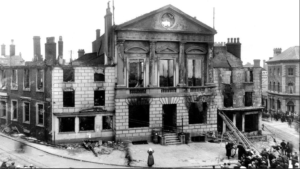
The war was seen as a way to reduce crime by enlisting criminals into the army and putting them to useful war work at a time of labour shortages. However, after the war there was a “moral panic” that returning veterans brutalised by war, would cause violent disorder in society. In January 1919 there was a series of soldier mutinies at Southwick, Folkestone, Dover, Osterley Park, Shortlands, Westerham Hill, Felixstowe, Grove Park, Shoreham, Brixton, Aldershot, Kempton Park, Southampton, Maidstone, Blackpool, Park Royal, Chatham, Fairlop and Biggin Hill, as well as at several London railway stations where troops refused to embark for Russia and France. On 3 January 1919, virtually the entire garrison at Folkestone refused to attend reveille in protest at poor food, excessive officer privileges and orders that they return to France. At a huge demonstration, 10,000-strong, the troops voted to form a Soldiers’ Union. On 19th July 1919, Luton Town Hall, was burnt down. Although blamed on Bolsheviks, the destruction was carried out largely by returning war veterans excluded from official Armistice Peace Parties.
Similar soldiers’ protests, strikes, riots and mutinies took place in cities, ports and barracks all over Britain well into 1919. Influenced by their working class and trade union roots – and the strong sense of camaraderie that evolved in fighting units during the war – the military rebels had genuine grievances and felt a burning desire for a fair deal. Faced with the threat of a generalised rebellion – and talk of revolution – army chiefs hastily improved conditions and speeded up demobilisation. They feared that keeping dissenting troops together and under arms could risk a revolution. They were right. In 1919, Britain came close to a workers and soldiers uprising. But it’s a story rarely mentioned in official WW1 commemorations.
Where crime statistics are available and crime was not reported in the depth, scale and detail as it is today, the 1914-1918 war actually witnessed a decline in reported crime, though they showed an increase in the proportion of offending by women and young people.
During World War 1, crime rates in the UK decreased significantly, with arrests and convictions, falling sharply as many men mobilised for military service. The war also created a high demand for labour, leading to better employment opportunities. Many policemen were serving in the military, reducing the force’s capacity to enforce laws. Economic conditions allowed people to pay fines more easily, which contributed to lower recorded crime rates. Arrests and convictions fell significantly as the war began. For example, convictions per 100,000 people dropped from 369 in 1913-14, to 118, in 1916-17. The number of murders known to the police was 102 in 1911, and although it was as high as 123 in 1919, by 1924 it had fallen again to 105. Similar decreases also occurred in the incidence of assaults, rapes and burglaries. The onset of world war in 1914 had reduced crime to near-negligible levels. By 1915 the prison population of England and Wales had dropped by 37,320 from the previous year, while in Scotland the number of prison committals was at its lowest since 1869. The prison authorities believed that the fall in crime was due to wartime restrictions on the sale of alcohol, increased employment, higher wages and, most notably, the enlistment of many petty offenders. They elaborated that ‘there is every reason to believe that the country’s call for men appealed as strongly to the criminal as to other classes’.
Recruiting criminals to the army in times of war is an old practice. Some thought violent criminals made good soldiers, others like, General Wolfe, in the war for Canada saw soldier criminals as “little loss”.
The numbers of UK criminals enlisting increased over the course of WW1, with shortages of manpower and the need for other essential war work. The army was not particularly concerned about previous convictions in any event. According to the King’s Regulations, civil convictions committed prior to enlistment could not be used as evidence during a court martial. As the war progressed and recruiting standards slackened, criminals were more readily accepted into the army. In 1916 the Northern Whig praised the ‘Scallywag Heroes’ who had rushed to the colours. Some like, Rifleman, William Mariner, a pre-war convicted house breaker, won the Victoria Cross in 1915 and when he was killed in action on 30 June 1916, his criminal past was rarely mentioned.
As the need for manpower became greater, courts began to more readily allow convicted men to enlist. This trend was undoubtedly influenced by the Military Service Act 1916, which enacted the conscription of all eligible men between eighteen and forty-one years of age. The deputy chairman of Essex quarter sessions informed the home office in 1917 that he and his colleagues believed a man should not be able to avoid military service by committing a felony.
During the war it was common for soldiers tried in civilian courts to be sent back to the forces rather than imprisoned. Civilian courts had the power to try soldiers who broke the law, but they could not order a man out of the army.
It is known that criminals joined WW1 via the Courts, the borstal system, local jails and convict prisons. The Commissioners of Prisons for England and Wales reported that in the first year of the war alone 340 juveniles had been liberated from institutions for military service. Based on the annual reports of the commissioners, some 958 juveniles were recruited directly from English and Welsh borstals during the war.
Similarly, in the first year of the war, the Polmont Institution, Scotland’s main centre for juvenile offenders, had provided ninety-four boys for the army. By 1918, 344 boys had been liberated so as to join the army and one in the navy. In total, 365 boys, including those who had enlisted while out on licence, entered the army during the war. A further eleven juveniles were also given early release from Barlinnie in 1916.
Early release in exchange for enlistment was also carried out at the Clonmel borstal in Ireland. In total, 376 ex-inmates had enlisted during the war, 165 of which had been recruited directly from Clonmel. Among the former Polmont inmates, four were awarded the Military Medal, while another received the D.C.M. By 1916, at least twenty had been killed and between forty and fifty wounded. Most of the boys who were released early appear to have stayed out of trouble, at least for the duration of their time in uniform. Of the 361 inmates listed as being released from Scottish borstals for war service, only eight were liberated a second time after being imprisoned again.
Although adult criminality fell during the war, juvenile delinquency was on the increase, and there was a shortage of resources to deal with the problem. Between 1914 and 1915 the number of persons proceeded against at juvenile courts in England and Wales rose from 36,929 to 43,981. By 1917 the figure had peaked at 51,323, and remained above pre-war levels after the armistice. Female prisoners were not released during the war. However, they laboured out of patriotic duty knitting socks and gloves for front line soldiers, but their efforts were belittled as a means to ingratiate themselves with servicemen.
Prisons were also keen to enlist prisoners to reduce costs. The annual cost per prisoner rose significantly during the war, from £30 in 1914 to £56 in 1917, due largely to increasing costs in clothing, fuel and provisions. In England and Wales, the total cost of victualling all local prisons rose from £77,279 in 1916 to £137,503 by the end of the war. There were also problems with staff shortages; 41 superior officers, 53 clerks and 824 subordinate officers enlisted by 1918, with no new subordinate staff being hired since 1915. In his 1933 history of Dartmoor, A. J. Rhodes stated that he had discovered a roll of honour for 284 prisoners who had been killed during the war. In terms of medals, there was a V.C., a Russian Order of St. George, as well as several D.C.M.s and Military Medals. Rhodes refrained from naming the prisoners so as to preserve their reputations as good soldiers. (Dartmoor Prison: A Record of 126 Years of Prisoner of War and Convict Life, 1806-1932)
The Commissioners of Prisons in July 1920 reported that out of a total prison population of under 40,000, 6,461 were men who served in the armed forces, of which 3,411 were first time offenders and 1,398 ‘habitual criminals’, the remainder being prisoners transferred from military prisons in France. The report highlighted that “A large proportion of these ex-soldiers were young men, some earning good wages at the time of their committal and that they were not prompted to commit crime because of want but through sheer lawlessness – which may not have been due to criminal instincts, but generated by the conditions of active service in different parts of the world, where the normal restraints of conduct had been banished by the stress of war.’
Crime still went on during the war. Newspaper stories acted as a lurid alternative to reports on the war. They included – ladies’ man, bigamist and serial killer, George Smith (1872-1915) who was hanged on 13 August 1915, for murdering his third wife for insurance money. Also, bestselling novelist and self-publicist, Marie Corelli, whose reputation ended when she was fined for hoarding sugar in 1918.
The Times reported for 1919, 110 cases of murder, attempted murder and threats to murder. The News of the World reported the same stories with another 17 cases. Soldiers and demobbed soldiers were identified suspects in 42 of the 127 cases (one third). In 49 of the cases, the suspect or killer was identified as a member of the same family as the victim or victims. Fifteen cases involved the death of an infant under the age of one year; mothers were the suspects/killers in eight of these cases, and no suspect was identified in four cases where the child was unknown or unidentifiable. Five of the ‘murders’ involved women dying as the result of an abortion, commonly described in the press as ‘an illegal operation’. In only eight instances was it clear that the violence involved an assailant and a victim who were strangers to each other. Five of the latter concerned robbers firing revolvers at police officers or bank managers. A sixth case involved a drunken ex-soldier who, taking exception to the comments of a 17-year-old girl while he was walking with a woman in Great Yarmouth, slashed her across the throat with his razor. The court found him insane.
There was a moral panic that veterans brutalised by their war experiences would increase crime after the war. In 1919 there were a number of homicides committed by ex-servicemen. Clive Emsley researched a number of these and Richard P. Hughes recorded them in his book the Sandhills Murder. They concluded that the moral panic was exaggerated. Some of these crimes were not brutality caused by war, but domestic upheaval created by it. For example, in January 1919, Lieutenant Colonel, Norman Rutherford, RAMC, shot Major, Miles Seton, under the delusion that the Major had an evil influence over his wife and children. The jury gave Rutherford the benefit of the doubt, concluding that he was guilty, but insane.
In April 1919, Sergeant, Arthur Pank, of the Military Police shot dead his sister in law, for suspected infidelity, while his brother was at the front. Returning war veteran, Henry Gaskin, a Staffordshire miner, cut off his wife’s head. Lewis Massey, a blacksmith striker, beat his wife to death with a poker. Both were sentenced to death and executed.
John Crossland, wounded at Mons, and imprisoned for two weeks for not paying child maintenance, returned to his Blackburn home and suffocated his wife, Ellen Crossland. He claimed that another man had moved in. The Jury found him guilty, but recommended mercy.
James Ryan, a recently discharged soldier from the Duke of Cornwall Light Infantry, attempted to murder New Zealand soldier, Algernon Worgor, at Oatlands Park hospital on 7th June. Worgor who was in a bed at the time had lost a leg in the war, was stabbed five times, for allegedly stealing Ryan’s “wife and four babies”.
Albert Swanson, a demobbed soldier, wounded Henry Maguire for having an affair with his wife and was fined £5.
Corporal, George Lawrence, “thrashed” his wife’s lover, but was granted a divorce and custody of his children.
Private, Henry Canham, whilst on leave, shot and killed his unfaithful wife Gladys with a revolver. During his absence in France, Mrs Canham apparently led an “Immoral Life” and was often seen with Australian soldiers. She had informed Private Canham she had contracted a venereal disease from an Officer before he shot her. The Old Bailey Jury accepted a plea of manslaughter (not murder) and he was bound over to keep the peace for two years (Times 1st Feb 1918).
Between January 1919 and December 1920, 70 men who had served in the armed forces during the war were convicted of homicide in England, Scotland and Wales, with 51 being found guilty of wilful murder and sentenced to death. Of these, 24 were hanged, 16 judged to be guilty, but insane and committed to asylums, and 11 had their death sentences commuted.
While statistics available show a reduction in war time crime, it is acknowledged many crimes went unrecorded and London, for example remained the crime capital during the World War 1, particularly for violent crime. With thousands of soldiers passing through London every week, to the Western front, London became a breeding ground for criminal activity. The night time black outs meant streets were dark and dangerous. For example, Canadian Soldier, Alfred Williams, aged 26, was robbed and murdered at St Martin’s Lane, on 26th November 1916. Opportunities for robbery, pilfering, illegal drinking in back street dens, unlicensed gambling and prostitution were rife during the war. There was also a brisk trade in fake medical exemption certificates for new conscripts in 1916.
Organised crime which pre dated WW1, flourished in London during and after the war. We know this through the diaries, novels and newspapers accounts of organised criminals, like Charles Darby Sabini who led a Sicilian-Irish mafia in Clerkenwell, London, his rivals the Cortesi brothers from Saffron Hill, Jimmy Spink’s Hoxton gang, Arthur Harding, a notorious East End criminal, and Billy Kimber’s Birmingham Boys, which was largely made up of London criminals. The Sheffield gang wars, also reveal gangs never left Sheffield and more crimes were committed during WW1 than the years either side. For example, one hundred deserters were rounded up at Sky Edge in 1916 for illegal gambling racquets. Several gang members were deserters, who had been conscripted and spent most of the time absent without leave. The hidden criminal underworld by its secretive nature would rarely report crime and the full extent of crime during WW1 may never be known
Where war time statistics are available, crime rates for men in the UK decreased significantly. However, there was a recoded increase in offending by women and young people. Between 1914 and 1915 the number of persons proceeded against at juvenile courts in England and Wales rose from 36,929 to 43,981. By 1917 the figure had peaked at 51,323, and remained above pre-war levels after the armistice.
Some notable crime historians, like Clive Emsley, say crime fell during and after the First World War, that most war veterans transitioned successfully back into society and assumptions about post war crime waves were exaggerated. Other sources like History Today say crime between 1915 -1930 increased by 5% each year. Parliament UK reports that homicides increased after war. For example, over the 1920’s, there were 8.3 homicides for every million people in the UK – up by 0.2% on the previous decade.
Crime statistics are no measure of the level of offending in WW1. Crimes against property have always significantly outnumbered crimes against the person. Statistics may illustrate the overall pattern of crime, but also reflect policing policy, and financial constraints upon the criminal justice system during the war. Cultural pressures also encouraged low reporting of certain crimes. These included physical assaults or beatings which upheld “family honour”. These rarely went to court. Domestic violence was also kept behind closed doors and rarely discussed publicly. Crime detection was also distorted by staff shortages within the police, prisons and judicial system which weakened law enforcement. The increasing cost of prisons, also meant less sentencing. As the war progressed, leniency was shown to criminals who were prepared to enlist or undertake work like packing and munitions for the war effort. As such we may never know whether WW1 increased violent crime or more crimes occurred because of greater freedoms and a decrease in social restrictions. Crime was also not recorded in the detail like today. There were no Government Departments, statistical agencies and specialist social workers, psychiatrists, criminologists, like today, that would have studied and recorded crime in detail. There was no welfare state as we know it and far fewer welfare institutions, offering support which would also have recorded violence and monitored incidents. Criminal offending by military service personnel has been the subject of little academic inquiry. We may never know how much crime was influenced by the First World war, or the economic depression after the war, or whether crime was impacted by half a million war orphans and fatherless children growing up in deprivation during the 1920-1930’s.
Sources:
‘Likely to make good soldiers’: mobilizing Britain’s criminal population during the First World War by Cameron McKay Research, Volume 94, Issue 265, August 2021, Pages 578– 600, Published: 27 May 2021
Soldier, Sailor, Beggar man, Thief: Crime and the British Armed Services since 1914 by Clive Emsley (1944-1920). Oxford: Oxford University Press (2013)
Violent crime in England in 1919: post-war anxieties and press narratives by Clive Emsley: Cambridge University Press (2008)
