The First World War was a watershed moment. It killed millions and restructured global power. It generated a quantum leap in industry, military technology, medicine, culture and international politics – a legacy that shaped the Twentieth Century. The phrase “lost generation” described not just the loss of lives, but the disillusionment felt by survivors after World War I. The loss of faith in traditional values and ideals led many who came of age during World War I to become hedonistic, rebellious, aimless and “lost.” This cynicism and disillusionment defined the literary and creative landscape of the 1920s. In Britain, the Lost generation took on an another meaning, in that the disproportionate losses amongst the social elites, robbed the nation of high achievers and weakened Britain as a superpower.
All over the world and in many aspects of life, people challenged and rejected the past. The pre war era of Imperialism, Capitalism and Enlightenment were seen as the causes of war. The world now sought new alternatives. After WW1, revolution, and republicanism flourished. New ideologies, such as Communism and Fascism also emerged, promising a different world order. Old Empires soon fell apart, creating new nations, mass democracy and the rise of “people power”. Government’s which had expanded their powers and responsibilities to win the war, were now expected to win the peace, by managing health, welfare and taxation. Women were granted the vote and more political rights for their war service. The war accelerated Modernism in arts, culture and literature. This rejected traditional convention, for more innovative ways to convey human experience and emotion. The war also renewed the interest in Pacifism, with diverse groups, forming the Woman’s Peace Party, and the American Union Against Militarism. Their message of peace, non violence and protest, influenced public opinion on war and conflict for decades. A League of Nations a pre curser to the United Nations was created to prevent further wars. These legacies of World War I, continue to shape global politics, society, and military strategies today.
The unprecedented violence and destruction caused many to re-evaluate beliefs about human nature and morality. The Great War was soon revealed as not the war to end all wars. The new world order emerging after the war, widened the world and made politics international. It fuelled more global tensions, conflict, rebellions and uprisings throughout the 1920’s. Civil wars soon broke out in Ireland, the Balkans, and Russian States. The creation of new territories in the Middle East, such as Arabia, Iraq, Syria, Lebanon and Palestine, sparked resistance movements to challenge European dominance. All over the colonized world, new nationalist sentiments emerged in the wake of World War I. Many in Asia and Africa adopted and adapted European ideas about nationalism to begin their own, long march toward independence.
The legacy of the Great War still resonates. Many of the current problems in the Middle East can be directly traced to the boundaries and territories that were drawn up directly after the First World War. The 700,000 war dead left in France, made Britain very reluctant to involve itself in Europe again. Even today Britain is still undecided to be a part Europe. The War forced America to emerge from isolation, and become the World Superpower which dominates today.
While the meaning of the Great War has changed over time, it is possible after 110 years to take a more balanced view. It is becoming accepted that the Great War was not a ‘bad’ or ‘unjust’ war, at least from an Allied point of view. It was fought against military aggression and to protect the sovereignty of small states, as well as the integrity of British power. The war had a powerful democratising affect, with people who fought it, demanding a new place in society for the ordinary citizen. The Britain we’ve inherited today and it’s citizen democracy grew out the sacrifice of World War 1. What went wrong was the bad peace that followed WW1. We can now remember the scale of sacrifices made at the time, the moving stories of the “Pals’ regiments, the horrors of battles, such as Gallipoli, the Somme, and Passchendaele, without allowing any doubts about the justice of the war, preventing our respect for the fallen.
The Lost Generation
This “Lost Generation” was a term used for the generation of young people who came of age at around the time of WW1 and died in the war. It also referred to the disillusionment of those who survived the war, as they struggled to find a new meaning to life.
Authors William Strauss and Neil Howe define the Lost Generation as the cohort born from 1883 to 1900, who came of age during World War I and the “Roaring Twenties”. In America, Gertrude Stein coined the phrase the “Lost Generation”. This was popularised by Ernest Hemmingway in his 1926 novel “The Sun Also Rises” and refers to the “disoriented, wandering, directionless” spirit of many of the war’s survivors in the early post war period. In Europe, they are mostly known as the “Generation of 1914”, for the year World War I began. In France they were sometimes called the Génération du feu, the “(Gun)fire Generation”.
In Great Britain, the term was originally used for those who died in the war, but often implicitly referred to upper-class casualties who were perceived to have died disproportionately, robbing the country of a future elite. Many felt that “the flower of youth” had been wiped out in its prime. Notable casualties, included the poets Isaac Rosenberg, Rupert Brooke, Edward Thomas and Wilfred Owen, composer George Butterworth and physicist Henry Moseley” While the majority of men returned from the war, the myth of the “Lost generation” endured. Britain certainly lost a large number of high achievers during the war and some families in a short space of time, lost all sons, heirs and breadwinners. In cities like Hull, for example, over a hundred families lost two or more men from the same family. At least ten Hull families, lost three sons and four Hull families lost four sons in the war.
The cohort of young men born between 1883 to 1900, were mobilized on a mass scale for WW1, a conflict that was often seen as the defining moment of their generation, Over six million men served in WW1, 70% who served were under 30 years old, as were 74% of those killed. Men under 20 years old, were most likely be killed (more than one in six), as were men between 20-24 years old (one in seven). Roughly, 58% of all Scotsmen, Welsh and English and 15% of Irishmen, aged 15-19, in 1911, served in the war. Approximately, 25% of eligible men volunteered for war (2,675,149 men). Conscription at ages 18-41 came into force in Britain on 1st November 1916, but was never enforced in Ireland. Approximately, two thirds of these men served in the British army and 80% of all those killed were infantrymen, some 450,000 in all. Most of them died in France and Flanders. For every nine men sent to the Western Front, five were killed, wounded and missing, more than any other theatre of war. These men came from all walks of life. The Board of Trade estimated that 750,000 or 10% of the industrial workforce enlisted in the first two months of the war. By February 1915, another 5% had enlisted, By February 1916, 29% of all industrial workers were in uniform. The War Emergency Worker’s National Committee estimated 115,000 miners enlisted at the outbreak of war. By February 1916, 15.6% of all agriculture workers had joined. Ten percent of Railway workers volunteered at the outbreak of war and by 1915, this had risen to 17%. By February 1916, 40% of men employed in banking, finance, commerce, accountants, architects, solicitors, advertising agents, estate managers, men in entertainment trades, hotels, pubs, theatres, music halls, cinemas and restaurants had joined up. By July 1917, 58% of all men employed in commerce were in uniform. Between 1914-1916, 30% of all manual workers and 40% of non manual workers had enlisted in the war. One in eight men were killed in the war (12.9%). More than one in four were wounded. Casualty rates in the army were higher than the Navy (6.8%) and Royal Air Force (2.1%), where respectively one in 16 and one in 50 were killed. The proportion wounded in the army was ten times higher the other two services. The health of these men varied according to occupation and social class, The healthy and educated social elites, were the most likely to be recruited. They were also more likely to become Officers, be expected to lead from the front and had a higher risk of being killed. From the working classes, Miners, particularly from Wales, were the most likely to become good soldiers and NCO’s. The National Service Medical Board, in probably the first National Survey of Men’s health in Britain, examined 2.5 million recruits between 1917-1918. They graded the health of newly conscripted men as follows, Grade 1, 36%, Grade 2, 22.5% and Grades 3 and 4, as 41.5%. In other words, over one million men recruited during the last year of the war, were unfit for foreign service. If their health of the working classes had been the same as the social elite, Britain would have recruited 1.7 million men. In the end, they recruited less than half of that, with many of those rejected assigned garrison duties, sedentary jobs or returned to domestic war work. The average measurements of the Grade 4 recruits, were 4 foot, 9 inches tall, 84lbs weight and 30 inch chest measurements. The urban poor of London, Leeds, Leicester, Stockport, Lancashire and Cheshire showed the worst fitness levels in Britain. This was a result of poor housing, limited education on nutrition and hard working conditions. The shocking findings would spur on housing and health reforms after the war. (These demographic figures are from J M Winters, The Lost Generation, Population Investigation Committee, published in 1977,)
Young women in this “Lost generation” cohort, also contributed to and were affected by the War. In its aftermath they gained greater freedoms politically and in other areas of life. While the depletion of men reduced marriage prospects and led to a decline in European birth rates, they found ways to marry by emigration abroad, moving to Cities with higher male populations and marrying across classes.
The “Lost Generation” was also heavily vulnerable to the Spanish Flu Pandemic and became the driving force behind many cultural changes, particularly in major cities, during what became known as the “Roaring Twenties. Later, they experienced the economic effects of the Great Depression and often saw their own sons fight and die in the Second World War. In the developed world, this generation tended to reach retirement and average life expectancy during the decades after the conflict, but some significantly outlived the norm.
As young adults, more than 70 million people were mobilized during the First World War. Approximately, 10 million military personnel and 7 million civilians died in World War 1, with some 23 million wounded – an estimated casualty total of 40 million people. 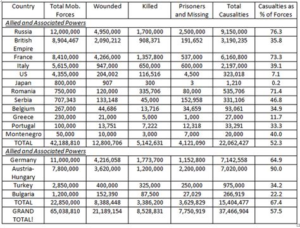 The Great War was defined as a World War because nearly half the casualties, were civilians.
Around 60 million of the enlisted, originated from the European continent, which saw its younger men mobilized on a mass scale. Most of Europe’s great powers operated peacetime conscription systems where men were expected to do a brief period of military training in their youth before spending the rest of their lives in the army reserve. Nations with this system saw a huge portion of their manpower directly invested in WW1: 55% of male Italians and Bulgarians aged 18 to 50 were called to military service. Elsewhere the proportions were even higher: 63% of military-aged men in Serbia, 78% in Austro-Hungary, and 81% of military-aged men in France and Germany served. Britain, which relied primarily on the Royal Navy for its security, was a notable exception to this rule and did not introduce conscription until 1916. Around five million British men fought in the First World War out of a total United Kingdom population of 46 million including women, children, and men too old to bear arms. Additionally, nations recruited heavily from their colonial empires. Three million men from around the British Empire, outside the United Kingdom, served in the British Army as soldiers and laborers, whilst France recruited 475,000 soldiers from its colonies. Other nations involved, include the United States which enlisted four million men during the conflict and the Ottoman Empire which mobilized 2,850,000 soldiers. Beyond the extent of the deaths, the war had a profound effect on many of its survivors, giving many young men severe mental health problems and crippling physical disabilities. The war also unsettled many soldiers’ sense of reality, who had gone into the conflict with a belief that battle and hardship was a path to redemption and greatness. When years of pain, suffering and loss seemed to bring about little in the way of a better future, many were left with a profound sense of disillusionment.
The war also had a personal impact on the lives of female members of the Lost Generation. Many women took the jobs men had left in previously male-dominated sectors, such as heavy industry, while some even took on non-combat military roles. Many particularly wealthier women took part in voluntary work to contribute to the war effort or helped those suffering, such as the wounded or refugees, often experiencing manual labour for the first time. However, this reshaping of the female role led to fears that the sexes having the same responsibilities would disrupt the fabric of society and that more competition for work would leave men unemployed and erode their pay. Most women had to exit the employment they had taken during the war as soon as it concluded.
Many women lost their husbands in the conflict, which frequently meant losing the main breadwinner of the household. However, war widows often received a pension and financial assistance to support their children. Even with some economic support, raising a family alone was often financially difficult and emotionally draining, and women faced losing their pensions if they remarried or were accused of engaging in frowned-upon behaviour. In some cases, grief and the other pressures on them drove widows to alcoholism, depression, or suicide. Additionally, the large number of men killed in the First World War made it harder for many young women who were still single at the start of conflict to get married; this accelerated a trend towards them gaining greater independence and embarking on careers. Women’s gaining of political rights sped up in the Western world after the First World War, while employment opportunities for unmarried women widened. This time period saw the development of a new type of young woman in popular culture known as a “flapper”, who was known for their rebellion against previous social norms. They had a physically distinctive appearance compared to their predecessors only a few years earlier, cutting their hair into “bobs”, wearing shorter dresses and more makeup, while taking on a new code of behaviour filled with more recklessness, party-going and overt sexuality.
The immediate post war period was characterized by continued political violence and economic instability. The aftermath of WW1, saw substantive changes in the political situation, including a trend towards Republicism, the founding of new nation-states which had previously been part of larger empires, and greater suffrage for groups, such as the working class and women. France and the United Kingdom both gained territory from their enemies, while the war and the damage it did to the European empires are generally considered major stepping stones in the United States’ path to becoming the world’s dominant superpower. The German and Italian populations’ resentment against what they generally saw as a peace settlement that took too much away from the former or didn’t give enough to the latter fed into the fascist movements, which would eventually turn those countries into totalitarian dictatorships. For Russia, the years after its 1917 Revolution were plagued by disease, famine, terror, and civil war and eventually concluded in the establishment of the Soviet Union. The “Spanish Flu” pandemic, killed many younger adults of the same Lost Generation age group that had mainly died in the war. Later, especially in major cities, much of the 1920s is considered to have been a more prosperous period when the Lost Generation in particular escaped the suffering and turmoil they had lived through by rebelling against the social and cultural norms of their elders.
This more optimistic “Roaring Twenties” was short-lived, however, as 1929 saw the beginning of the “Great Depression”, which would continue throughout the 1930s and become the longest and most severe financial downturn ever experienced in Western industrialized history. Though it had begun in the United States, the crises led to sharp increases in worldwide unemployment, reductions in economic output and deflation The Depression was also a major catalyst for the rise of Nazism in Germany and the beginnings of its quest to establish dominance over the European continent, which would eventually lead to the Second World War 1939-1945. Additionally, the 1930s saw the less badly damaged Imperial Japan engage in its own empire-building, contributing to conflict in the Far East. Some scholars have argued that the Second World War began as early as 1931 with the Japanese invasion of Manchuria.
The 1930s saw the rising popularity for radio, with the vast majority of Western households having access to the medium by the end of the decade. Programming included soap operas, music, and sport. Educational broadcasts were frequently available. The airwaves also provided a source of news and, particularly for the era’s autocratic regimes, an outlet for political propaganda.
When World War II broke out in 1939, the Lost Generation faced another major global conflict for the second time in their lifetime, and now watched their own sons go to the battlefield. The place of the older generation who had been young adults during World War I, was a theme in popular media of the time period, with examples including Waterloo Bridge and Old Bill and Son. Civil defence organizations designed to provide a final line of resistance against invasion and assist in home defence, more broadly recruited heavily from the older male population.
Like in the First World War, women helped to make up for labour shortages caused by mass military recruitment during World War 2. They again entered more traditionally masculine employment and enlisted n female military branches and underground resistance movements. However, those in middle age were generally less likely to become involved in this kind of work than the young. This was particularly true of any kind of military involvement.
In later life, the Lost Generation in the West, tended to reach the end of their working lives around the 1950s and ’60s. For those members of the cohort who had fought in World War I, their military service was frequently viewed as a defining moment in their lives even many years later. Retirement notices of this era often included information on a man’s service in the First World War.
Though there were slight differences between individual countries and from one year to the next, the average life expectancy in the developed world during the 1950s, ’60s and early ’70s was typically around seventy years old. However, some members of the Lost Generation outlived the norm by several decades. For example, Nabi Tajima, from Japan was the last surviving person known to have been born in the 19th century. She died in 2018, aged 117. The final remaining veteran to have served in World War I in any capacity was Florence Green, who died in 2012, while Claude Choules, the last French veteran to have been involved in combat, had died the previous year. Thus ended the unique generation that experienced the First World War.
https://www.theguardian.com/world/2014/jan/15/firstworldwar